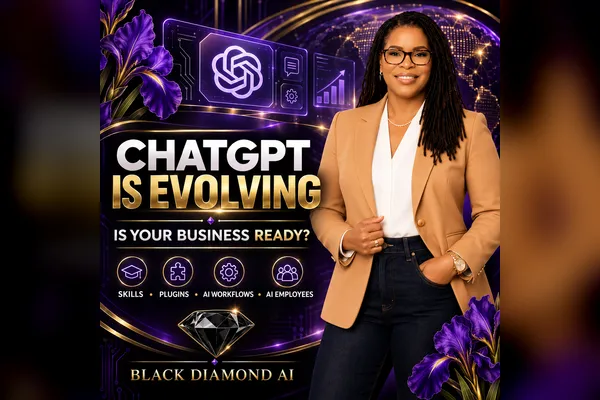
ChatGPT Is Evolving: Is Your Business Ready for the Next Generation of AI?
ChatGPT Is Evolving: Is Your Business Ready for the Next Generation of AI?
“AI is not replacing the vision of great leaders; it is expanding their ability to turn that vision into action. The businesses that prepare today will lead the workforce of tomorrow.”
— Dr. Iris Wright, Founder of Black Diamond AI

Artificial intelligence is entering a new stage, and business owners must be prepared for what comes next. ChatGPT is evolving beyond basic conversations and traditional custom assistants into a more connected environment that can use skills, plugins, business tools, files, data, and automated workflows.
For entrepreneurs who have already invested time creating custom GPTs or AI employees, this evolution may initially feel overwhelming. You may wonder whether your previous work will become obsolete or whether you will need to start over.
The encouraging news is that the work you have already completed still matters.
Your prompts, knowledge bases, standard operating procedures, brand guidelines, employee descriptions, policies, workflows, and training materials can become the foundation for your next generation of AI employees. The technology may evolve, but the business intelligence you have built remains valuable.
From AI Assistants to AI Workforces
Many business owners currently use ChatGPT to write emails, create social media posts, develop marketing materials, answer questions, and brainstorm ideas. These functions are helpful, but they represent only part of what artificial intelligence can offer.
The next generation of AI is becoming more action-oriented. Instead of only generating information, AI systems can increasingly work with approved tools and structured processes to help complete business tasks.
An AI employee may support customer service, organize documents, qualify leads, prepare reports, assist with onboarding, manage routine follow-ups, or guide a team through an established workflow. With the proper systems and human supervision, several specialized AI employees can operate as a coordinated digital workforce.
This does not mean AI should replace every human employee. It means organizations can use AI to reduce repetitive work, improve response times, support consistency, and allow people to focus on responsibilities requiring judgment, creativity, compassion, and leadership.
What Skills and Plugins Change
Skills give an AI system structured instructions for completing a particular type of work. A skill may teach an AI employee how to prepare a report, follow an onboarding process, create a marketing campaign, review a document, or complete another defined responsibility.
Plugins and connected tools allow AI to work with approved external systems and information. Depending on the available technology and permissions, these connections may help an AI employee retrieve information, update records, work with documents, or support business workflows.
This is an important transition. A knowledgeable AI assistant can provide recommendations, but a properly designed AI workflow can help move a task from beginning to completion.
However, greater capability also requires stronger governance. Businesses must determine what information an AI employee can access, which actions it can take, when human approval is required, and how its work will be reviewed.
Your Previous Work Is Not Wasted
If you have already created custom GPTs or developed AI employee personalities, do not discard your work. Instead, organize and prepare it for migration into a more advanced structure.
Begin by reviewing each AI employee’s role, purpose, instructions, knowledge, tone, workflows, and limitations. Remove outdated information, separate responsibilities clearly, and identify which tasks require human approval.
Your existing materials can be transformed into:
Role-specific AI skills
Organized knowledge libraries
Repeatable operating workflows
Responsible-use policies
Quality-control procedures
Human approval checkpoints
Connected business processes
The strongest AI employees will not be built from one large prompt. They will be developed through organized instructions, reliable knowledge, appropriate tools, clearly defined permissions, and ongoing supervision.
Preparing Your Business for the Transition
Businesses should approach this evolution strategically instead of rushing to adopt every new AI feature. Start with one clearly defined business need. Determine the outcome you want, document the process, identify the necessary information, and establish how success will be measured.
Business owners should also protect confidential information and avoid giving AI unnecessary access to sensitive systems. Every AI employee should operate within a defined scope and be tested before receiving greater responsibility.
Responsible AI implementation includes transparency, privacy protection, accuracy reviews, documentation, accountability, and human oversight. An AI employee should know what it is responsible for and, just as importantly, what it is not authorized to do.
The Future Belongs to Prepared Leaders
ChatGPT’s evolution represents an opportunity for entrepreneurs, executives, and organizations willing to prepare. The businesses that benefit most from AI will not simply be those with access to the newest technology. They will be the ones with clearly designed roles, documented systems, responsible governance, trained leadership, and measurable objectives.
Through Black Diamond AI and The AI-Powered CEO Workforce Lab™, we are helping leaders design, train, supervise, test, and deploy responsible AI employees for real business roles. Our work continues to be guided by the W.R.I.G.H.T. Method™, ensuring that innovation is supported by strategy, accountability, and purpose.
AI is not going away. It is becoming more capable, connected, and action-oriented.
The question is no longer whether AI will change how we work.
The question is: Is your business ready?
— Dr. Iris Wright
Founder, Black Diamond AI